| Main | Deities A-Y | Cult Temples | History of Religion | Philosophy | Creation Myths | Festivals | Priesthood | Daily Life | Aset/Isis | Deities Specific | Abydos | Dendera | Karnak | Philae | Saqqara | Women | Other |

| During the Old Kingdom the Egyptian society moved from tribal communities to a fully developed theocratic system, where the power of the king was absolute. The great pyramids of Dynasty 4 was made possible by technological advances which also facilitated an increase of the general quality of life. But the vast resources that were needed to realize these great structures led in the end to the decline of kingship and of this period in history.
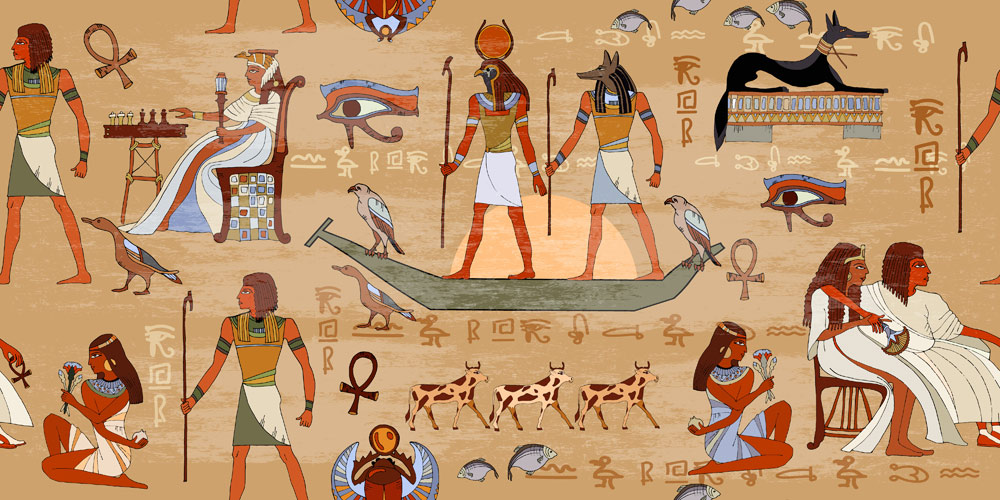
Religious and Political Development Religion and politics went alongside of each other at this time, as it most likely already did in the Predynastic Period. When a new family rose to kingly power, it was the custom to bring the local god which they had previously worshipped to a nationwide recognition. These local deities were innumerous and at the beginning of the Old Kingdom the situation was so confusing that an outright attempt was made by the priesthood to bring some order into it. As important religious centers had emerged at some cities, to gain power their different priesthoods started to develop individual theologies, each one aiming at placing their own god as the center of the creation of the universe. They also grouped the gods into enneads (groups of nine) and ogdoads (groups of eight) and made them appear as families. Re-Horakhte is the sun rising in the morning as a falcon soaring towards the sky and depicted in human form with the head of a falcon. Re-Atum is the sun when it sets in the evening. The name Re describes the physical presence of the sundisc in the sky and also the sungod 'shining in his disk'. Although many myths were associated with the sun, the Heliopolitan cosmogony was the most influential of the creation myths. Its main source are the Pyramid Texts. The belief was that the earth was flat and personified as the god Geb, over whom the sky, personified as the goddess Nut was arched while below the earth lay the Netherworld. The sun was thought to travel in his sunboat across the sky in the daytime, and at sundown he stepped over into the nightboat to cross through the night and the underworld, meeting and striking back all kinds of dangers until he emerged at the eastern horizon, climbing back into his dayboat. ![]() Ra in his boat The Heliopolitan Creation Myth deals with a grouping of nine gods - the Great Ennead (the Pesdjet): Atum, Shu, Tefnut, Geb, Nut, Osiris, Isis, Nephtys and Seth. Creating the World ![]() Pyramidion from Deir-el Medina, c 1300 BC. Atum was believed to possess both male and female potentialities within, according to the myth he copulated with his hand, which was here associated with the female principle within him, swallowed his seed and spat out Shu, the god of air, and sneezed out Tefnut, the goddess of moisture. These two begot Geb, the earth-god and Nut, the sky goddess and so the cosmic part of the Ennead was complete. Their children; Osiris, Isis, Nephtys and Seth were not considered cosmic and belong to other myths. The Royal Cult of Re-Atum From dynasty 2 onwards and reaching its height during dynasty 5, the cult of Re-Atum was unthreatened by other religious centers. Already at the beginning of this period, the kings had taken on the name: 'Son of Re'. Perhaps this indicates that the king had increased his status from being one of the gods to the actual son of the sun-god himself. There is also evidence that suggests that the kingship was dominated by the priesthood of Re in Dynasty 5. During this period the priesthood's power increased and the king's diminished. Royal members of the family no longer held high offices, provincial governors made their own decisions and the king's authority became undermined. If once the kings had acquired power with the help of the priesthood of Re, now they were probably made redundant by the same priesthood. Rivaling Cosmogonies There were several other creation myths and worship centers which tried to outrival the cult of Re-Atum. They all describe the events at the creation of the universe in more or less the same way as the Heliopolitan cosmogony; a primeval island rises out of the chaos waters and the world comes into being. And like Heliopolis, each priesthood claimed that their god's temple was situated at the very hill which was the Primeval Mound where creation had once begun. After this first event development was thought to proceed slowly until a golden age was reached where the gods ruled and ethics, morale and law were installed. Later the king was thought to be the heir of the gods and thereby the upholder of MaŽat on earth so that the divine rule would continue among humans. The other theological center which tried to outdo the cosmogony of Heliopolis was that of Ptah at Memphis. His priesthood tried to assert him as preceding Re-Atum and thus identified him with Nun who begot a daughter Naunet and with her Nun begot a son named Atum, which was the same as the Heliopolitan Atum. According to the Memphite theology Ptah created the universe using his heart and his tongue. For the ancient Egyptians the heart was the seat of thought, not the brain. By uttering the name of all things he brought them into being, for according to Egyptian belief the name held the essence of a being or a thing. In this way he even created all the gods. The theology of Ptah seems to suggest a synthesis of the mind and the material world, and maybe one can discern in this a shadow of the priesthood debating and arguing of how to formulate the principles behind this creation myth.
Other articles in this series:
1: Predynastic - Early Dynastic Period (ca 5000 - 2686 BC)
2: The Old Kingdom (ca 2686-2181 BC)
4: First Intermediate - Middle Kingdom (ca 2181 -1786 BC)
5: The New Kingdom (ca 1580 -1085 BC)
6: The Cult of Aten (ca 1350 - 1335 BC)
7: The End of The New Kingdom - Third Intermediate
8: The Late Period - Graeco-Roman Period
Copyright 2000 - 2008. All right reserved. |