Main Deities A-Y Cult Temples History of Religion Philosophy Creation Myths Festivals Priesthood Daily Life
Aset/Isis Deities Specific Abydos Dendera Karnak Philae Saqqara Women Other


Akhet - The Horizon


Religion in Ancient Egypt:


Basis 1: Ma’at and the Eternal Return


Maat

Ma'at

The ancient Egyptian story of how the world began, tells us that in the Beginning, before existence came into being, all was Chaos. Nothing else existed, everything was turmoil and darkness. Then Ma'at, the principle of order, justice and balance, was the first idea to separate from the primeval nonexistence. By the idea of Ma'at the basic laws for creation and structuring of the universe was formed and creation culd begin.

"Ma'at is eternal and has not changed since the time when she came into being"
(Ptahotep)


The concept of Ma'at, personified as a female deity, is the focal point in the philosophy of the ancient Egyptians. It pervades thinking on all levels of existence: the cosmological level, the ideology of kingship, the social level and the individual level. You will find it on all these levels. It is too vast a topic to be more than touched upon briefly here but the concept of Ma'at is intimately connected to the oldest of the creation myths; Atum at Heliopolis, and is known as far back as the Old Kingdom. We can be pretty sure it goes even further back.

Atum is the "self-created One" and when Atum had given life to Shu and Tefnut, by his androgynous powers, the Coffin Texts state him saying:

"Tefnut is my living daughter and she shall be together with her brother Shu; his name is Life and her name is Ma'at."

Without Life and Ma'at there is no possibility of creation, which basically is movement. Dynamics and differentiation must be guided by an ordering, structuring, regulating principle. Thus Ma'at is an integrated part of the Creator god himself:

The Eternal Return

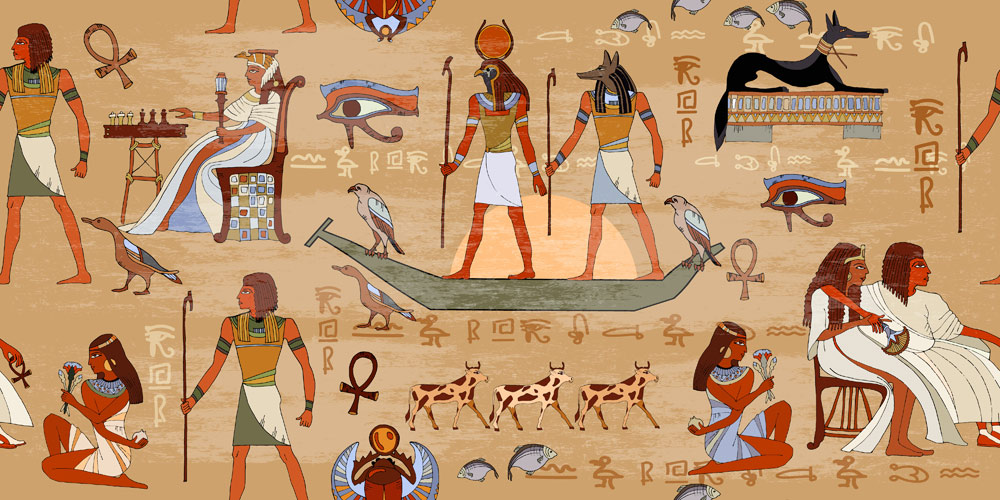
Out of Creation the sun, Re, is born, to travel from east to west, measuring the time and growing older for every passing hour of the day, until he dies and disappears into the Underworld below the horizon. The ordering and structuring principle of Ma'at is thus at work, ensuring that things are balanced, and that there will be a Rebirth the next morning. Therefore Ma'at travels with Re in the day boat at day and in the night boat during the night, keeping the course and stopping the destructive forces from engulfing the boat.

Behind all this lay the perception of existence as eternal and circular. It was not linear as we think of it. What had happened at the first moment of Creation, (called Zep Tepy: "the First Time"), would be repeated over and over again. From Predynastic times the Egyptians were a farming people, they were familiar with the fact that seeds planted in the ground returned as harvest the following year, just like the sun rose every morning. But when destructive forces like draught and famine threatened their existence, people believed the gods to have left them. It was the gods who guaranteed existence for the ancients, without the gods there would be no life, no order or prosperity, only chaos and disorder. Therefore it was vital to keep the gods satisfied and wanting to stay in Egypt, and this was an everyday occupation that had to be maintained all year round. On the social level it was taken care of by the priesthood in all temples throughout the Two Lands, and on the individual level one turned to the village shrines of local gods and the personal shrines that probably existed in every Egyptian home.

"O Re, Lord of Ma'at
who lives by Ma'at
who rejoices in Ma'at
who is complete because of Ma'at
who persists because of Ma'at
who is praised by Ma'at
who is powerful through Ma'at
who rules through Ma'at
who is crowned by Ma'at
who ascends in Ma'at
who descends in Ma'at
who nourishes on Ma'at
who is joined with Ma'at
O Re, eternal in deed, perfect in plans
righteous in heart, who establishes Ma'at
in everything which he creates...!

To make a full turn back to where we began - the one responsible for upholding Ma’at on Earth was the King. He was the gods representative on earth. He ruled by the authority of Ma'at. The foremost offering of the King was to present Ma’at to the gods, which can be seen on innumerable reliefs from all periods. Likewise it was common for kings to use the name ‘Beloved of Ma’at’, in their titulary, as a reflection of their function for the Two Lands. By 'doing Ma'at' the King fulfilled his responsibilities towards God and Man alike.


Sources:
Temples of Ancient Egypt - edited by Byron Shafer
The Priests of Ancient Egypt - Serge Sauneron
Religion and Magic in Ancient Egypt - Rosalie David
Photo: Seti I offers Ma'at in his temple at Abydos. (author w many excuses for poor quality!)


Sources:
Temples of Ancient Egypt - edited by Byron Shafer
The Priests of Ancient Egypt - Serge Sauneron
Religion and Magic in Ancient Egypt - Rosalie David

Copyright 2000 - 2008. All right reserved.
No text or images may be used without permission from
the webmistress or the photographer.
This site is for educational purposes only.

Contact


Home - Gods - Temples - Priesthood - Creation Myths - Women - Wisdom Texts - History - Sitemap