Main Deities A-Y Cult Temples History of Religion Philosophy Creation Myths Festivals Priesthood Daily Life
Aset/Isis Deities Specific Abydos Dendera Karnak Philae Saqqara Women Other


The Egyptian Gods

their main centers of worship
and some festival days


On this page: Ra, Renenutet, Reshef,

Please note - Festival days are an estimation compiled from several sources.


Ra/Ra'


  Ra, or Re, originally meaning the heavenly body itself. He is undoubtably one of Egypt´s most important deites, perhaps the most important of them all. An early cult center existed at Iunu (Gr: Heliopolis.modern Cairo) in the Old Kingdom Period and though Re might not go as far back as Horus - Heru, he kept his position while incorporating several other deities during time. From Herakhty, which he joined already early on as the morning sun, Re adopted the falcon head and when he later also coalesced with Atum, Re-Atum became a manifestation of the setting sun. In the Middle Kingdom, when the cult of Amun rose to power, Re still kept his position and he and Amun became Amun-Re.

The universality of Re is demonstrated in his broad variety of composites; he was known as Re-Herakhty-Khepri and he was ominpresent both in the heavens, on earth and in the underworld. Further, his function is likewize as creator god and father to the king.

Already in Dynasty 2, the king´s name Raneb is reflecting Re, and in Dynasty 4 it was usual that the rulers called themselves 'Son of Re' and built sun temples at Iunu (Heliopolis).

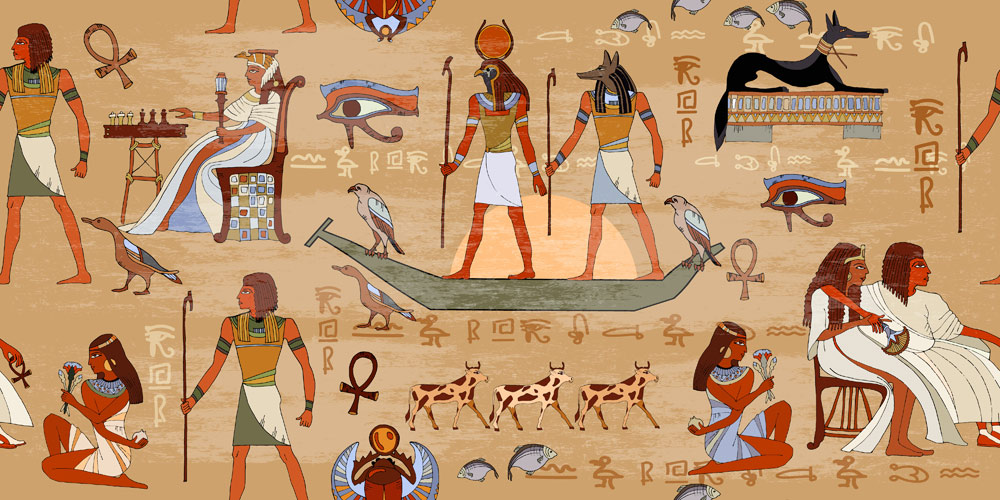
Re travelled across the sky in his sun-boat, the 'Boat of Millons of Years', from sunrise to evening, accompanied by his Vizier Thoth and his daughter Ma´at. His day-bark was called Mandjet and his night bark whicih he changed to at the day´s end, Mesketet. When the sun set below the horizon, Re was said to travel in the underworld, meeting all kinds of danger until he finally was reborn again in the Eastern sky.

Re was also a creator. At Heliopolis and also other theological centra, he was a supreme creator who emerged from the primeval waters when time began, and created everything on land, sky and water. Several versions of this myth exists, in one he was said to come into being on a mound or a lotus flower which rose from the waters. He was then in the shape of a child, or a heron, a scarab, a beetle or even soem other animal. It was also said that Re created man (remetj) from his tears (remut). In another version he cut his own phallus and man was created from the drops of blood. But in all versions, he was the one whho created all other living beings, and was therefor called both father and mother of all mankind and animals. As Re was the creator, he also created kingship and was the first king. He ruled the earth until he became old and withdrew to heaven, where he became the ancestor of all kings, meanwhile continuing to rule.

Myths about Re are several, noteworthy among them is the one where Isis forces him to reveal his secret name to her.

Re appeared in many forms.The sundic surrounded by a cobra wa a common one. He could als be depicted as a man with a falcon´s head, or a ram´s, or a scarab´s. He could appear as several animals: falcon, serpent, cat, bull, lion, heron. In his morning, noon and evening form he was seen as a combined figure: a beetle, solar-disc and ram-headed man. He could fuse with other deities, llike Amun-Re, and also Re-Osiris He was mostly depicted witout a female counterpart, though Raet, or Raettawy had been his "spouse" already since the 5th Dynasty.


Main center of worship:

Iunu/Heliopolis, 13 th Nome, Lower Egypt


Festivals: (dates compiled from various sources and not neccesarily correct.)

6th August - 19th Thuti - Festival of Nut and Ra

17th August - 30th Thuti - Rituals in the Temples of Ra, Horus and Osiris

26th August - 9th Paopi - Day of Jubilation in the heart of Ra

9th october - 23 Hethara - Ra judges the dispute of Set and Heru (Horus).

31st October - 15th Koiak - Feast of Sekhmet, Bast and Ra

15th November - 30th Koiak - The Ennead feast in the House of Ra, Heru and Wasir

6th December - 21st Tybi - Day of offerings to the Shemsu (followers) of Ra

16th December - 1st Mechir - Day of Ptah lifting up his hands

17th December - 2nd Mechir - Day the Netjers of Heaven receive Ra

4th March - 19 Parmutit - Feast of Ra in his Barge at Heliopolis

15th March - 30th Parmutit - Offerings to Ra, Wasir, Heru, Ptah, Sokar and Atum

21st March - 6th Pachons - Coming Forth of the Great Ones of the House of Ra

2nd april - 18th Pachons - Day of Joy of the Ennead and crew of Ra

14th April - 30th Pachons - Celebrations in the House of Ra, Wesir (Osiris) and Heru (Horus)

16th April - 2nd Payni - Holiday of Ra and His Shemsu (followers)

9th May - 25th Payni - The Akhet Eye pleases Ra

26th May - 12th Epipi - Holiday of the receiveing of Ra

30th May - 16th Epipi - Ma´at is taken to Ra in Heliopolis

1st June - 18th Epipi - Ma´at and Ra Go Forth in secret

28th June - 15th Mesore - Ra Goes forth to propitiate the Nun

13th July - 30th Mesore - Birthday of Ra


Top of Page


Renenutet/Renenet


  "Lady of the fertile land" and "lady of granaries", a deity of fertility and harvest but she was also a protector of linen, especially bandages, children and their nourishment. Mother of the grain god Nepri. She also gave each child a destiny and she attended the weighing of the hearts of men in the Hall of Judgment. The Greeks called her Thermutis. Her name consisted of two parts:`rnn´ - nourishment, and `wtt´ - snake, showing something of her character. People made offerings to her during harvest time and she was depicted either as a snake or a human with a snake´s head. In the Greco-Egyptian days she was often depicted as Isis with a snake´s head. Her main cult center was Faiyum in Lower Egypt.


Main center of worship:

The Faiyum area, Lower Egypt

Top of Page


Reshef/Reshpu


  A Syrian war and thunder god, always depicted with raised weapons, wearing the White Crown of Upper Egypt with a streamer flowing from the top. At the base of the crown is either a complete head of a gazelle or just the horns. In the Pyramid Texts mentioned as replacing the guardian of the celestial gates, Khay-Tau, a foreign deity, probably from Byblos.


 All the Egyptian Deities A - W:

A 
 B   D   G   H   I   K   M   N   O   P   R   S   T   U   W   Y 

Or go direct to some of them:

Amun, Anubis, Aset - Bast -Djehuty - Hathor, Horus - Isis - Khepri - Ma'at -

Nephtys - Osiris - Ptah - Re - Sekhmet, Seth - Thoth - Wadjet, Wesir


Copyright 2000 - 2008. All right reserved.
No text or images may be used without permission from
the webmistress or the photographer.
This site is for educational purposes only.

Contact


Some sources:

Temples of Ancient Egypt - Dieter Arnold
Temples of the Last Pharaohs - Dieter Arnold
The Pyramid Texts - transl: R.O. Faulkner
The Coffin Texts - transl: R.O. Faulkner
Egyptian Myths - by George Hart
A Dictionary of Egyptian Gods and Goddesses - George Hart
The Complete Gods and Goddesses of Ancient Egypt - Richard H. Wilkinson

My special thanks to House of Netjer for allowing me to draw from their knowledge of the Netjeru!


Home - Gods - Temples - Priesthood - Creation Myths - Women - Wisdom Texts - History - Sitemap