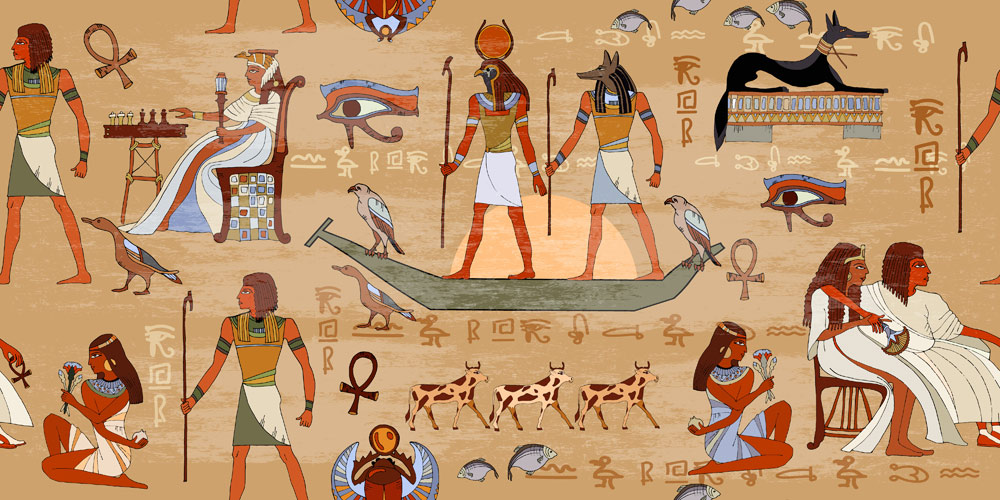
For more info on these deities click on their names above. Below is just a brief guide.
Anhur
'He Who Brings the Distant One'. Ancient god of war and hunting whose origin is This in Upper Egypt, near Abydos. Anhur was depicted in bearded, human form and carrying four feathers on his head, a spear or sometimes a lance lifted high in one or both hands. He resides in the desert at the edge of the world from whence, according to myth, he brings back the eye of the sun, in this case his consort by name of Mekhit.
Bat
Primeval deity from the 7th Upper Egyptian Nome, it is probably her who is depicted on the Narmer Palette (ca 3100) with cow's horns and two faces. Her cult center seems to have been in the 7th Nome of Upper Egypt. The name of Bat is thought to be the feminine form of the word 'b3'; soul. In Utterance 506 (§1095), the king identifies himself with 'Bat with Her two faces'. There are also references to the 'great wild cow'. There were strong connections between Het-Hert (Gr: Hathor) and Bat, though they had differing origins. As their iconography showed such likeness, it has created quite som confusion among scholars.
p>Heru-Wer - Horus the Elder
Horus the Elder or the falcon or hawk, soaring with outstretched wings was already in Predynastic times seen as the sky-god, his eyes were called the sun and the moon. He is depicted on Predynastic pottery and in the royal serekh, marking the king´s name from this period. In ancient Kemetic the word Her or Heru means 'The One on High' or 'The Distant One', referring to the falcon soaring in the sky. The sky, the sun and the falcon were at this time equaled with the king and out of this came the symbol of the winged disc which was one of the many forms of Heru/Horus. This became the royal insignia, used on lintels over doors of temples and royal buildings, as well as in many other places. This is the form which refer to him as "Horus the Elder", or 'Heru-Wer'. In Kom-Ombo he was identified as the son of Re and it is likely that the ancient falcon god of Nekhen (Gr: Hierakonpolis), 'City of the Hawk', from Predynastic times, is the same as Horus.
Khentamentiu
This name means'Foremost of the Westerners' and is rather one of the titles of Yinepu (Anubis) than a specific deity. Khent-Amentiu appears as a local deity in jackal form at Abedjou. He was worshipped at the necropolis there as the leader of the deceased; the 'Westerners'. During the early Old Kingdom he became assimilated with Wesir, who assumed his place.
Nekhbet
The Name of Nekhbet is the same as the Egyptian name for 'mother' and she was also considered one of the mythical mothers of the King and protector of Upper Egypt. In the Pyramid Text she is referred to as: Mistress of Per-Wer,(the Most Sacred Place), She of Nekheb and White Crown. From the beginning she was a local god of Nekheb, situated opposite the ancient city of Nekhen, where it is believed that the pre- and early Dynastic kings might have lived.
Already in early times she became the tutelary goddess of the King, together with Wadjet, the cobra goddess of Buto in Upper Egypt. They are referred to in the Royal Titualary as the nebty name, or the Two Ladies name.
The first depiction of Wadjet and Nekhbet is an engraving on a tablet from the 1st Dynasty, where they are seen sitting on their baskets.
Nit (Neith)
Nit (Gr: Neith) much later a local goddess of Zau (Gr: Sais), but known as early as the Predynastic and Early Dynastic Period when her influence probably was at its height. Earliest traces are her hieroglyph (crossed arrows on a shield) on a pole in front of the reed shrines and on pottery from Dynasty I in Abydos. Nit is sometimes a goddess of war, sometimes the patroness of weawing, a mortuary goddess and in later times an androgynous Creator.
Although Nit probably originated in Libya, the earliest traces comes from Upper Egypt. Her influence seems to have been at its height in the Predynastic and Early Dynastic Period. She is not documented in writing before the last part of the Predynastic period, but there is evidence of her before that time.
Her hieroglyph; two crossed arrows on a shield, was carved on a pole in front of the primitive reed shrines and on pottery, also on funerary stelae from Early Dynastic tombs at Abedjou and Diaspolis Parva (Hut-Sekhem, 7th Nome), and on an inlaid amulet from a tomb at Naq-el-Deir, and even on the roof of boats. There is also a wooden label from Abedjou which appears to show King Aha (c. 3100 BC) visiting a shrine to Nit. These findings indicate that she was important all over Egypt already at an early stage in history. At Abedjou she was connected to the rites of renewal of the king´s power.
More about Nit.
Wadjet
Uadjet, Wadjet, Uajyt or Edjo, goddess of Buto Lower Egypt. Her name means "the papyrus-colored
one", i.e. "the green one", which was a general name for
the cobra.
Already in early times she became the tutelary goddess of the King, together with Nekhbet, the vulture goddess of Nekheb in Upper Egypt. They are referred to in the Royal Titulary as the nebty name, or the Two Ladies name.
The first depiction of Wadjet and Nekhbet is an engraving on a tablet from the 1st Dynasty, where they are seen sitting on their baskets.
Her main cult center was in the northwest delta, especially the two ancient towns Pe and Dep, which were called Buto together.
Wesir, Gr: Osiris
The name Osiris is the Greek word for the hieroglyph 'Wesir' or Wsr', which is thought to mean 'He who is strong', but no definite conclusion has been reached. It is also thought to mean 'the place of the eye'. Other varieties of the spelling and pronouncing of his name are Ausar or Usir, and of course Osiris, which is the Greek version.
Wesir/Osiris has been called "Lord of the Duat (Afterworld)", "Judge of the Blessed Dead", "Father of the Kings" and many other epithets. There exists much discussion about the origin of his name, and its´ meaning, though the most likely explanation seems to be that his name is related to the word 'woser' which would mean 'Mighty One'.
There have been various theories as to the origin of Wesir/Osiris, one places him as being a foreign human king during the Predynastic times, entering Egypt from the North and settling finally in Djedu (Busiris) in Lower Egypt, where his cult center grew. Another theory is that he developed from the primitive fertility god, Nepri, in Lower Egypt to become one of the greatest and most important of all the Egyptian deities, whose myth still lived on long after the fall of Egypt.
The title Foremost of the Westerners belonged to the ancient Egyptian deity at Abedjou, Khenti-Amentiu. In the Old Kingdom Wesir replaced him as a funerary god at Abedjou.
Osiris at Abedjou
During the Old Kingdom Wesir/Osiris seems to have absorbed the ancient canine deity at Abedjou (Abydos), Khenti-Amentiu and replaced him as the main deity there. The name Khenti-Amentiu means 'Foremost of the Westerners' was also included in the long line of epithets for Osiris.
Abedjou was situated on the west bank of the Nile, the area where the sun sets and prepares to descend into the Duat. It is also here where many cemeteries and necropolii were placed in the ancient days, and it was also here that the Festival of Wesir was held annually.